My Midnight Sky Revelation
My Midnight Sky Revelation
The desert air bit my cheeks as I fumbled with numb fingers, cursing the freezing tripod. My photography group had trekked three hours into Joshua Tree's pitch-black wilderness chasing the Perseids meteor shower. "Just point your lens northeast at 2 AM," the workshop leader had said. But under this alien canopy, every constellation looked identical. Panic prickled my neck when Maria asked why Vega seemed brighter than usual tonight - I'd built my entire Instagram persona as an amateur astrophotographer yet couldn't distinguish Orion from Ursa Major. My credibility evaporated like dry ice in the August heat.
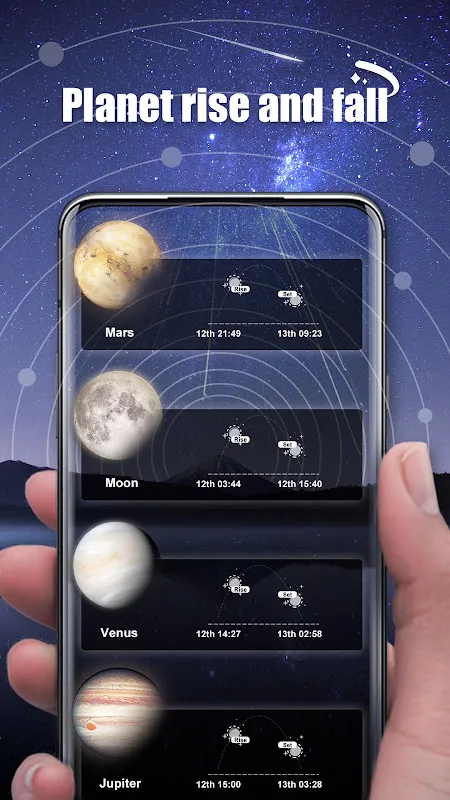
Then Jake's phone glowed like a miniature supernova. "Try this," he mumbled, thrusting his device toward Cygnus. Suddenly, the inky void transformed. Gyroscopes and accelerometers worked in silent concert as his screen overlaid pulsating labels over each celestial body. I watched in disbelief as real-time positional algorithms accounted for our GPS coordinates, altitude, and even atmospheric distortion - technology I'd only seen in observatory-grade telescopes. When he tapped a flickering dot, the screen revealed it was actually Mars masquerading as a star, its iron oxide signature causing the reddish hue Maria noticed. The app didn't just identify; it explained atmospheric refraction like a patient professor.
When Technology Outshines Human ArroganceWhat shattered me wasn't the augmented reality overlay. It was the "Time Machine" slider. Dragging it backward to 1066 AD, the heavens rearranged themselves with terrifying grace. Polaris - our steadfast north star - drifted off-center as Earth's axial precession unfolded across my cracked iPhone screen. I physically staggered when realizing the light from Alnilam took 1,340 years to reach my retinas. That's when the app delivered its gut punch: "You're seeing Orion's belt as it appeared when Byzantine Emperor Justinian I reigned." Suddenly my fancy DSLR felt as primitive as a cave painting. The raw computational horsepower required to render celestial mechanics in real-time - accounting for gravitational lensing and relativistic effects - made my head spin faster than a pulsar.
But the magic turned to frustration at dawn. While packing gear, I tried capturing Venus' farewell. The app's interface became a laggy mess, overheating my phone as it struggled with twilight's low contrast. Battery percentage dropped like a meteorite - 40% evaporated in twenty minutes. Worse, its much-hyped meteor shower tracker failed spectacularly when a brilliant fireball streaked across Lyra. By the time the notification buzzed, the moment had evaporated into ionized gas. I nearly hurled my phone into a cholla cactus when its premium feature demanded $9.99/month to access "advanced comet trajectories."
The Universe in Your Pocket, With CaveatsBack in LA's light-polluted sprawl, I became obsessed. I'd stand on my fire escape at 3 AM, phone aimed like a sextant, tracking Jupiter's moons through smog. The app's social feature connected me with Elena in Madrid, comparing how Cassiopeia appeared inverted in her hemisphere. But urban stargazing revealed its limits. Without desert-dark skies, its object recognition faltered like a drunk astronomer. One Tuesday it confidently identified Sirius as the International Space Station, an error so laughable I screamed into my coffee. Yet when it worked? Pure sorcery. Watching it calculate the exact millisecond when Earth's rotation would align Saturn's rings with my balcony view felt like cheating physics.
Last week, I took my nephew to Malibu Creek. When he asked why the moon followed our car, I didn't spout canned facts. We aimed my phone skyward and manipulated the gravity simulation together, watching lunar orbital paths stretch and contract like rubber bands. His gasp when he "crashed" the moon into Jupiter by swiping too fast was worth every subscription fee. This digital planetarium won't replace telescopes, but it demolished my intellectual arrogance. Now when I shoot the stars, I frame my lens beside the phone's glow - a humbling reminder that technology illuminates precisely where human knowledge ends.
Keywords:Star Roam,news,astrophotography,celestial navigation,augmented reality